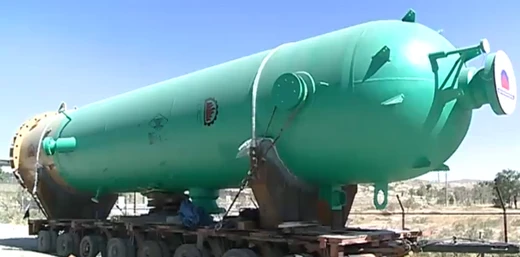
Fractional distillation
Separates liquid mixtures by boiling point using vaporization and condensation.

Fractional distillation is a separation process that divides a mixture into its component parts, or fractions, by heating to a temperature at which one or more fractions vaporize. It is used when the boiling points of the components differ by less than 25 °C under one atmosphere of pressure, and it plays a central role in refining crude oil and in many industrial chemical separations.
- field
- Chemistry, Chemical Engineering
- known_for
- Separation of mixtures by boiling point differences; key to petroleum refining
- earliest_attributed_works
- 9th-century works of Jabir ibn Hayyan
- common_laboratory_apparatus
- Fractionating column, round-bottomed flask, condenser, heat source
- industrial_scale
- Columns 0.65–6 m diameter, 6–60 m height
Lore & Background
The fractional distillation of organic substances played an important role in the 9th-century works attributed to the Islamic alchemist Jabir ibn Hayyan, as for example in the Kitāb al-Sabʿīn ('The Book of Seventy'), translated into Latin by Gerard of Cremona (c. 1114–1187) under the title Liber de septuaginta. The Jabirian experiments with fractional distillation of animal and vegetable substances, and to a lesser degree also of mineral substances, formed the main topic of the De anima in arte alkimiae, an originally Arabic work falsely attributed to Avicenna that was translated into Latin and would go on to form the most important alchemical source for Roger Bacon (c. 1220–1292).
Reader's Guide
Fractional distillation is the most common form of separation technology used in petroleum refineries, petrochemical and chemical plants, natural gas processing and cryogenic air separation plants. In most cases, the distillation is operated at a continuous steady state. New feed is always being added to the distillation column and products are always being removed. Unless the process is disturbed due to changes in feed, heat, ambient temperature, or condensing, the amount of feed being added and the amount of product being removed are normally equal. This is known as continuous, steady-state fractional distillation. Industrial distillation is typically performed in large, vertical cylindrical columns known as 'distillation or fractionation towers' or 'distillation columns' with diameters ranging from about 0.65 to 6 meters and heights ranging from about 6 to 60 meters or more. The distillation towers have liquid outlets at intervals up the column which allow for the withdrawal of different fractions or products having different boiling points or boiling ranges. By increasing the temperature of the product inside the columns, the different products are separated. The 'lightest' products (those with the lowest boiling point) exit from the top of the columns and the 'heaviest' products (those with the highest boiling point) exit from the bottom of the column. For example, fractional distillation is used in oil refineries to separate crude oil into useful substances (or fractions) having different hydrocarbons of different boiling points.
Did You Know?
- Fractional distillation is used when component boiling points differ by less than 25 °C under one atmosphere; simple distillation is used for larger differences.
- The earliest known works on fractional distillation are from the 9th-century Islamic alchemist Jabir ibn Hayyan.
- Some mixtures, such as water and ethanol, form an azeotrope that cannot be fully separated by fractional distillation alone.
- Industrial distillation columns can be up to 60 meters tall and 6 meters in diameter.
More in Chemical Reactors And Processes 1-24
Elsewhere in the Chemical Reactors And Processes universe
Spotted an error? Know more?
This is a living reference — every entry is fact-audited, and reader corrections feed straight into our audit queue. Suggest an edit · See this site's audit record