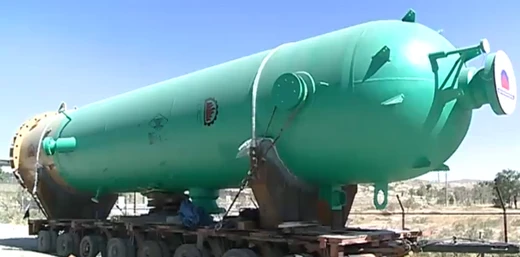
Batch reactor
Versatile vessel for non-continuous chemical reactions and batch processing.

Related names: Louter, David, transmitter Reynolds, Larry, photographer · Public domain
A batch reactor is a chemical reactor used for non-continuous reactions, where reactants, products, and solvent remain in the vessel until the target conversion is achieved. It is also applied, sometimes inappropriately, to batch fluid processing operations such as solids dissolution, mixing, distillation, crystallization, and liquid/liquid extraction, though such vessels may be termed by their specific function (e.g., crystallizer, bioreactor).
- type
- Chemical reactor
- operation
- Non-continuous (batch)
- typical_size_range
- Less than 1 L to more than 15,000 L
- common_materials
- Steel, stainless steel, glass-lined steel, glass, exotic alloys
- key_components
- Pressure vessel, agitator, heating/cooling system, baffles
- primary_industries
- Specialty chemicals, pharmaceuticals, wastewater treatment, laboratory applications
Lore & Background
Batch reactors are designed based on scale-up from laboratory processes, particularly for specialty chemicals and pharmaceuticals, with a recipe similar to cookery. A typical batch reactor consists of a pressure vessel with an agitator and integral heating/cooling system, fabricated in materials such as steel, stainless steel, glass-lined steel, glass, or exotic alloys. Liquids and solids are charged via top connections, vapors and gases discharge through the top, and liquids are discharged from the bottom. The agitator arrangement is a centrally mounted driveshaft with impeller blades covering about two-thirds of the reactor diameter; anchor-shaped paddles are used for viscous products. Baffles, stationary blades fixed to the vessel cover or side walls, break up flow from the rotating agitator. Mixing in large batch reactors is constrained by energy input, with mixing energies above 5 W/L burdening cooling systems, and high agitator loads causing shaft stability problems.
Reader's Guide
Batch reactors offer versatility by allowing a sequence of different operations in a single vessel without breaking containment, which is especially useful for toxic or highly potent compounds. However, they have limitations in mixing and heat transfer. Heating and cooling are managed via jackets or coils, with external jackets preferred for ease of cleaning. Three jacket types are described: single external jacket, half-coil jacket, and constant flux cooling jacket. The single jacket is the oldest but has sluggish temperature control and non-uniform distribution. The half-coil jacket provides faster fluid displacement (under 60 seconds) and uniform heating/cooling but still suffers from inlet temperature oscillations. The constant flux jacket, a recent development, uses multiple small elements to regulate temperature without altering jacket temperature, offering response times under 5 seconds and sensitive heat measurement for monitoring reaction rates. Batch reactors are used in wastewater treatment, pharmaceuticals, laboratory applications, and fermentation, but are noted for relatively high cost and unreliability in product quality.
Did You Know?
- Batch reactors can vary in size from less than 1 L to more than 15,000 L.
- Mixing energies above 5 W/L in large batch reactors can burden the cooling system.
- Cooling jackets in industrial batch reactors typically have temperature control response times on the order of minutes, not seconds.
- BOD reduction is characteristic of biological treatment processes like sequencing batch reactors, not standard chemical batch reactors.
The Simplest Vessel in Chemical Reaction Engineering
A batch reactor stands as the most fundamental configuration among chemical reactors, representing the entry point for understanding how enclosed volumes facilitate chemical transformation. In the broader discipline of chemical reaction engineering—a branch of chemical engineering focused on applying chemical kinetics to industrial systems—the batch reactor occupies a foundational position. Unlike its continuous counterparts, a batch reactor operates by loading all materials into a single vessel and allowing the reaction to unfold over time. It never achieves a steady state, meaning that key process variables such as temperature, pressure, and volume shift as the reaction progresses. This transient behavior distinguishes it sharply from continuous stirred-tank reactors or plug flow reactors, which are typically maintained at steady-state conditions. The design of such a reactor must account for maximizing net present value, ensuring the highest yield of desired product while minimizing capital and operating costs. Normal operating expenses in this context include energy input for heating or cooling, energy removal, raw material costs, labor, pumping to increase pressure, frictional pressure losses, and agitation. Chemical engineers balance all of these factors to ensure the reaction proceeds with the highest efficiency toward the desired output.
Transient Operation and the Necessity of Active Control
Because a batch reactor is inherently a transient system, its operation demands active management of multiple process variables simultaneously. When the vessel is brought into service—whether for the first time or after a shutdown—concentrations of each chemical species, temperature, and pressure all change with time, requiring continuous monitoring and adjustment throughout the reaction cycle. To accommodate these shifting conditions, batch reactors are typically fitted with multiple ports that serve as access points for sensors as well as for introducing raw materials and withdrawing finished products. The absence of a steady state means that the governing equations must be derived from differential mass and energy balances rather than the simpler algebraic balances used for steady-state continuous reactors. Temperature control may involve a heating or cooling jacket, or coils wrapped around the outside of the vessel wall, while pressure management may require pumping to increase pressure or careful accounting for frictional pressure losses. These operational demands make the batch reactor a system where precision in timing and parameter management directly determines the quality and yield of the final product.
Applications in Small-Scale and Biological Production
Batch reactors find their most natural home in small-scale manufacturing and in processes involving biological materials. The enclosed, self-contained nature of the vessel makes it well suited to brewing operations, pulping processes, and the production of enzymes, where the reaction mixture must be loaded, processed over a defined period, and then discharged before the next cycle begins. A pressure reactor serves as a common example of a batch configuration, where elevated pressures are maintained to drive the reaction forward. In these applications, the batch approach offers flexibility: different formulations or reaction conditions can be run in the same vessel without the extensive reconfiguration that a continuous system would require. The reagents and products in such reactors are typically fluids—liquids or gases—though the vessel may also accommodate solid reagents, catalysts, or inert materials. This versatility, combined with the relatively lower capital investment compared to large continuous plants, makes the batch reactor a practical choice for operations where production volume is modest but product diversity or biological sensitivity is paramount.
The Idealized Model and Its Place Among Three Fundamental Reactor Types
Chemical engineers rely on three idealized models to estimate the most important process variables across different reactor configurations: the batch reactor model, the continuous stirred-tank reactor model, and the plug flow reactor model. The batch model is the simplest of the three, describing a closed system in which all reactants are present at the start and the reaction proceeds purely as a function of time. Key process variables tracked in this model include residence time, volume, temperature, pressure, the concentrations of each chemical species present, and heat transfer coefficients. Many real-world reactors do not conform perfectly to any single idealized type but instead behave as combinations of these basic configurations. The batch reactor's transient character contrasts with the CSTR, where the reaction proceeds at the rate associated with the final output concentration under the assumption of perfect mixing, and with the PFR, where a spatial gradient in reaction rate develops as reagents travel through the tube. Understanding where a real vessel falls on this spectrum of models is essential for accurate prediction of yield and for optimizing the economic performance of the overall process.
Gallery
Frequently Asked Questions
What is a Batch reactor?
It is a sealed chemical reactor in which all reactants, solvent, and products are loaded together at the start and left undisturbed until the desired conversion level is reached. Unlike continuous systems, nothing flows in or out during the reaction cycle.
What are the key components of a Batch reactor?
A typical unit combines a pressure-rated vessel, an agitator for mixing, a dedicated heating or cooling circuit, and internal baffles that improve fluid circulation. These parts work together to keep temperature, agitation, and pressure under control throughout the batch.
How large can a Batch reactor get?
They span a huge size range, from sub-liter glass vessels in a teaching lab to industrial steel tanks exceeding 15,000 liters. Common construction materials include carbon steel, stainless steel, glass-lined steel, and exotic alloys for aggressive chemistries.
Which industries rely most on the Batch reactor?
Pharmaceuticals, specialty-chemicals production, wastewater treatment, and academic or R&D laboratories all depend heavily on batch operation. The vessel's flexibility makes it the go-to choice when a recipe changes from one production run to the next.
How does a Batch reactor differ from a continuous reactor?
In a batch setup the entire charge stays sealed inside the vessel for the full reaction time, so operators can adjust conditions mid-cycle. A continuous reactor, by contrast, maintains a steady inflow of reactants and outflow of products, which suits high-volume, single-product operations better.
More in Chemical Reactors And Processes 1-24
Elsewhere in the Chemical Reactors And Processes universe
Spotted an error? Know more?
This is a living reference — every entry is fact-audited, and reader corrections feed straight into our audit queue. Suggest an edit · See this site's audit record