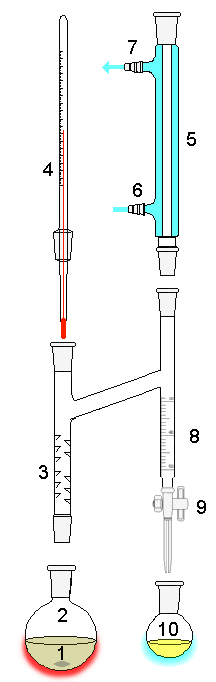
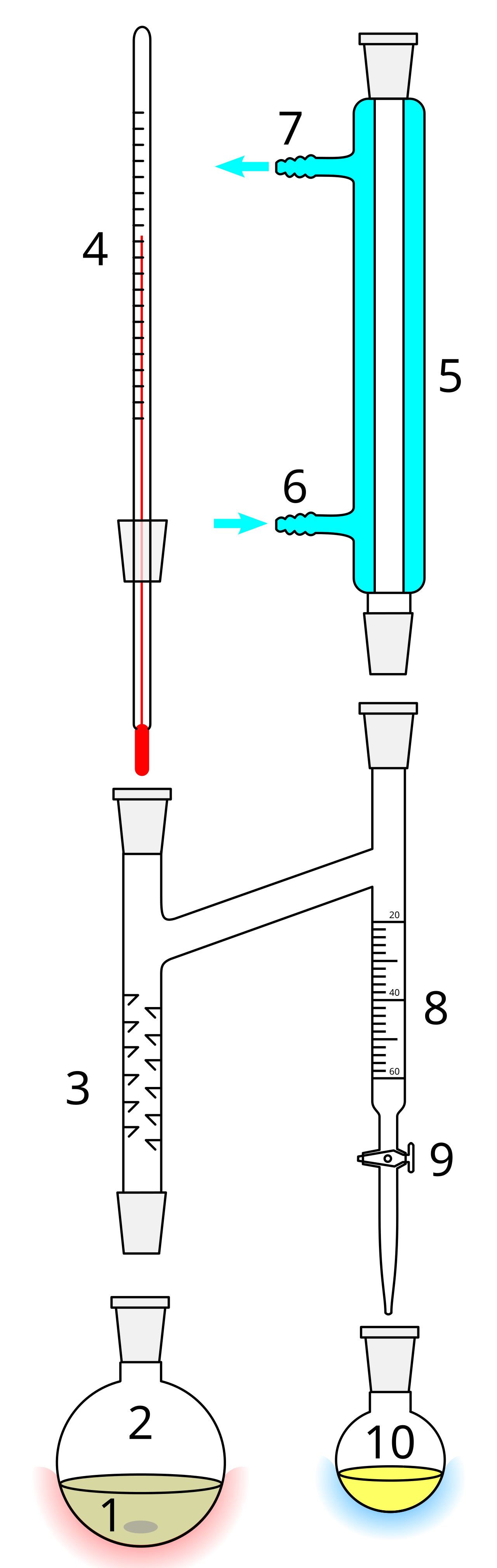
Dean–Stark apparatus
Laboratory glassware for separating water from reaction mixtures.

Vectorization: Slashme · Public domain
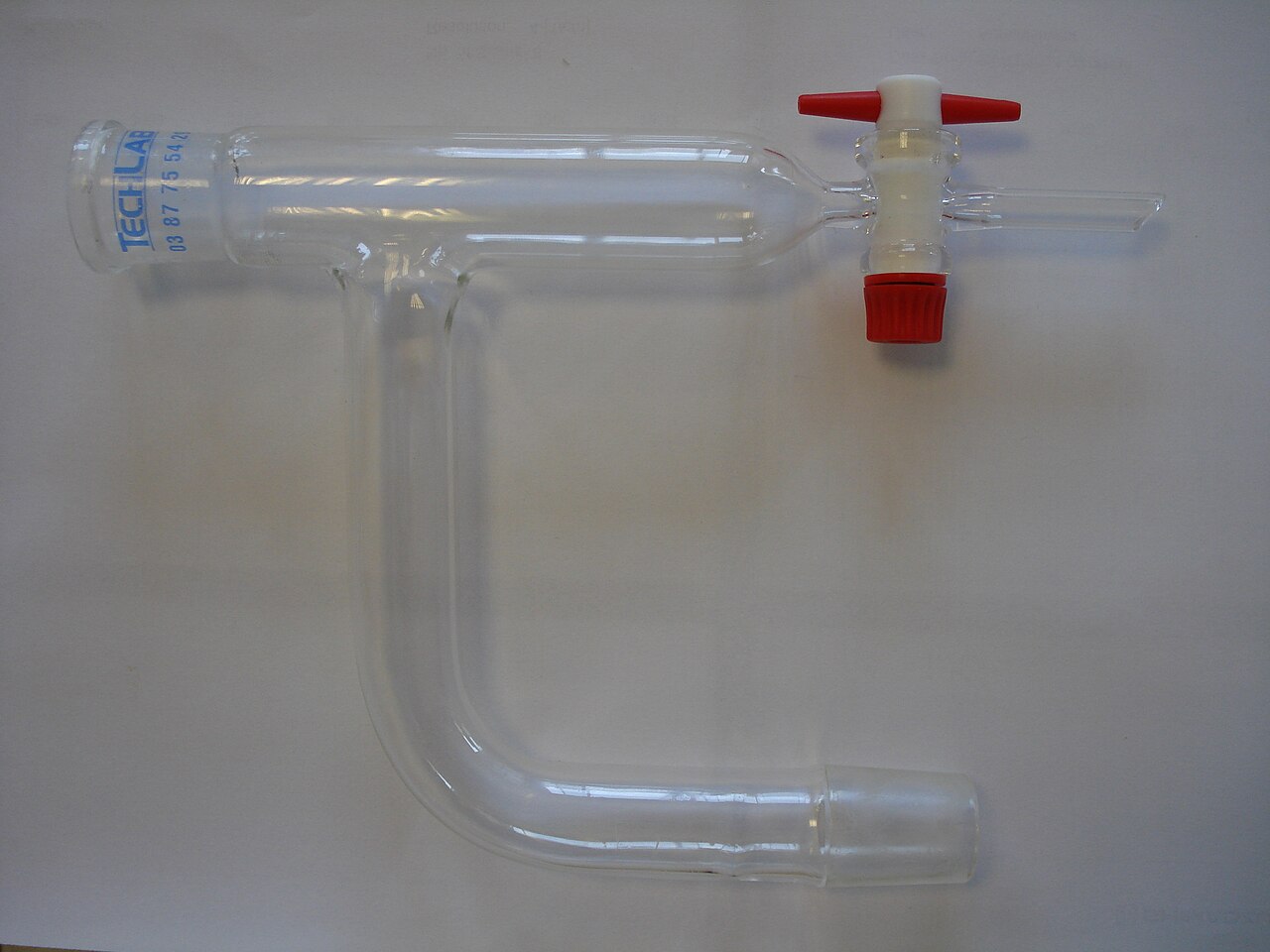
The Dean–Stark apparatus is a piece of laboratory glassware used in synthetic chemistry to collect water or occasionally other liquid from a reactor. It is used in combination with a reflux condenser and a distillation flask for the separation of water from liquids, often for continuous removal of water produced during chemical reactions at reflux temperature, such as esterification reactions. The apparatus was invented by American chemists Ernest Woodward Dean and David Dewey Stark in 1920 for determining water content in petroleum.
- inventor_original
- Ernest Woodward Dean (1888–1959) and David Dewey Stark (1893–1979)
- inventors_refined
- Ernest Woodward Dean (1888–1959) and David Dewey Stark (1893–1979)
- field
- Synthetic chemistry, petroleum analysis
- nationality
- American
- known_for
- Dean–Stark apparatus for water removal and measurement
Lore & Background
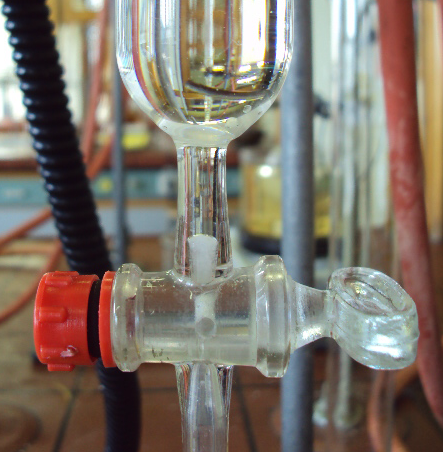
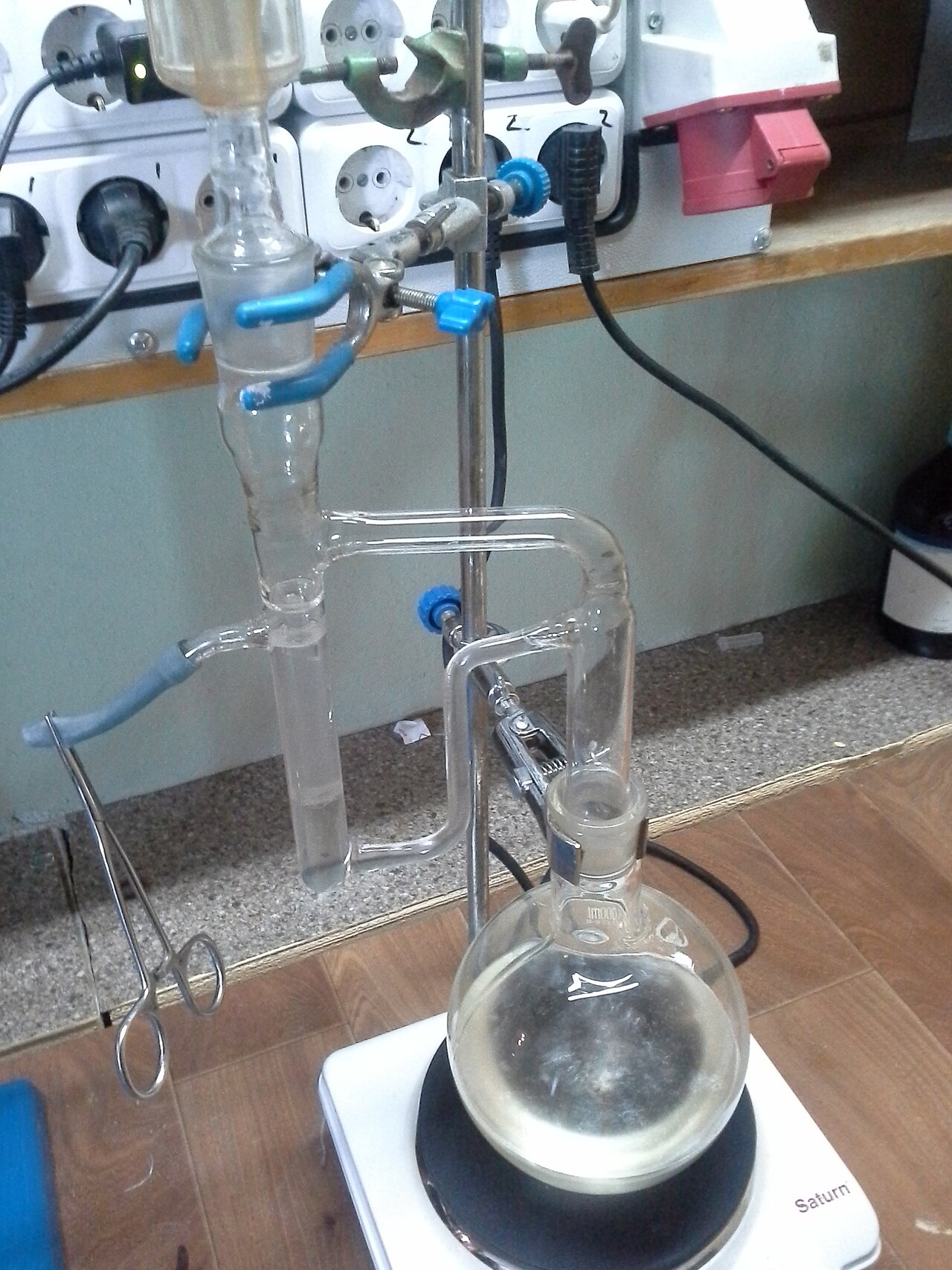
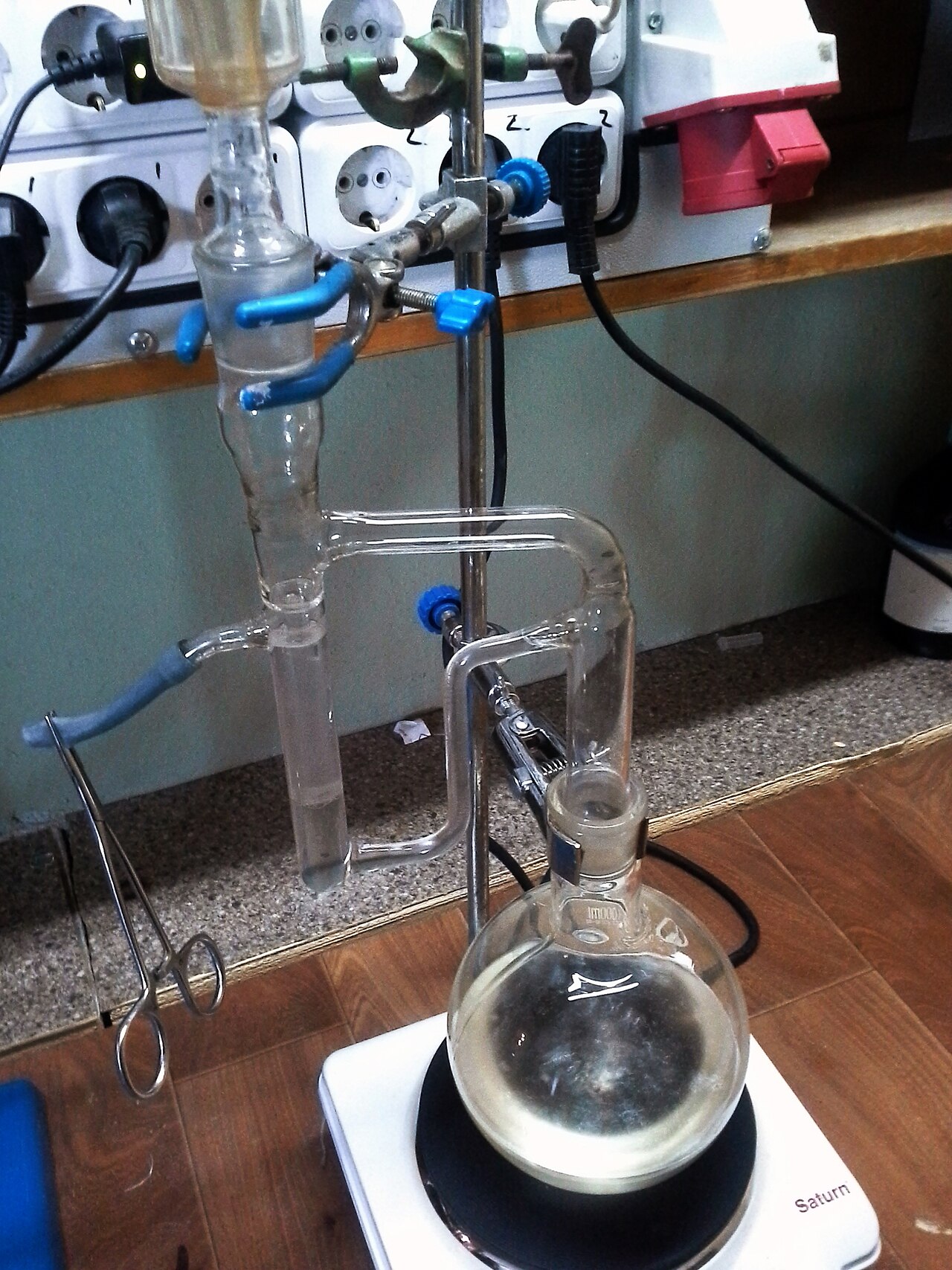
The Dean–Stark apparatus was invented by American chemists Ernest Woodward Dean and David Dewey Stark in 1920 for determining water content in petroleum. The apparatus typically consists of a vertical cylindrical glass tube with volumetric graduation and a precision stopcock, resembling a burette, with a reflux condenser fitting into its top and a sloping side-arm connecting to a reaction flask.
Reader's Guide
The Dean–Stark apparatus is significant for enabling the continuous removal of water from chemical reactions, such as esterifications, thereby shifting equilibrium toward product formation per Le Chatelier's principle. It is commonly used in azeotropic distillations, for example removing water generated in boiling toluene, where the toluene returns to the reactor while water collects in the trap. Two types exist: one for solvents less dense than water and another for denser solvents. The method is also used in the food industry to measure moisture content in items like bread. Its legacy lies in its simplicity and effectiveness for both synthetic chemistry and analytical determination of water content.
Did You Know?
- The Dean–Stark apparatus was invented by American chemists Ernest Woodward Dean and David Dewey Stark in 1920.
- The apparatus was originally designed for determining water content in petroleum and other organic solvents.
- Two types exist: one for solvents less dense than water and another for solvents denser than water.
- The Dean–Stark method is primarily used for determining water content in petroleum and organic solvents, not for measuring moisture content in bread.
Origins & Evolution
The apparatus we know today as the Dean-Stark receiver traces its roots to 1905, when Julius Marcusson first designed a setup for separating water from organic liquids in a laboratory setting. However, the configuration that became standard in synthetic chemistry labs emerged a full decade and a half later. In 1920, American chemists Ernest Woodward Dean (1888–1959) and David Dewey Stark (1893–1979) refined Marcusson's original arrangement, specifically adapting it to quantify the water content present in petroleum samples. Their work gave the device its most widely recognized name, though it has also been called the Marcusson apparatus, the distilling trap, or simply the Dean-Stark Head. The dual naming reflects how laboratory equipment often carries the legacy of multiple contributors across generations. What began as a petroleum-industry analytical tool gradually found broader utility in organic synthesis, where continuous removal of reaction-generated water became a critical need. The apparatus thus represents a case where an industrial measurement device evolved into a cornerstone of synthetic methodology.
Design & Separation Mechanism
The Dean-Stark trap is essentially a vertical cylindrical glass tube, graduated along its full length like a burette, with a precision stopcock at the bottom for drainage. The lower end of a reflux condenser seats into the top of this cylinder, while a sloping side-arm positioned just below that joint connects the cylinder to the reaction flask. The lower portion of the side-arm bends sharply downward, creating a vertical connection to the flask. When the flask is heated—often with boiling chips to ensure smooth vapor formation—vapor rises into the condenser, where circulating cooling water converts it back to liquid. The condensate drips into the trap, where immiscible liquids stratify: water settles below the organic solvent. As the combined volume climbs to the side-arm's level, the lighter upper layer overflows back into the reactor while water remains trapped. Once the water level itself reaches the side-arm, the trap is at capacity and must be drained. A rarer variant accommodates solvents denser than water, featuring a tube at the bottom of the collection vessel so the organic phase returns while water floats above.
Azeotropic Applications & Industrial Use
The Dean-Stark method shines in azeotropic distillations, where a solvent and water co-distill as a mixture but separate by density in the trap. A classic example involves boiling toluene (density 0.865 g/mL) with water (0.998 g/mL): the azeotropic vapor condenses, toluene floats and returns to the reactor, while water accumulates in the graduated tube. This principle extends to drying high-boiling liquids that form azeotropes with water—adding toluene or another azeotrope-breaking solvent enables water extraction that would otherwise be impractical. Beyond pure chemistry, the Dean-Stark technique is a standard moisture-determination method in the food industry, routinely applied to measure water content in products like bread. The versatility of the setup means it is not limited to simple water removal; it can also serve as a selective collection device for reaction products, making it a workhorse across both academic and industrial laboratories.
Shifting Equilibrium in Esterification
Perhaps the most chemically elegant application of the Dean-Stark apparatus is its role in driving esterification reactions to completion. In the sulfuric-acid-catalyzed esterification of butanol with acetic acid, the reflux vapor contains roughly 63% ester, 29% water, and 8% alcohol. Upon condensation in the trap, the organic layer—comprising 86% ester, 11% alcohol, and 3% water—flows back into the reactor, while the water layer, 97% pure, is retained and eventually drained. A similar strategy applies to the esterification of benzoic acid with n-butanol, where the ester product is collected in the trap while butanol, being immiscible with water, returns to the reaction vessel. By continuously extracting water, the apparatus shifts the chemical equilibrium toward ester formation in accordance with Le Chatelier's principle, dramatically improving yields that would otherwise plateau at lower conversion.
Gallery
Frequently Asked Questions
Who is Dean–Stark apparatus?
It is a piece of laboratory glassware built to pull water out of a reaction mixture while the remaining liquid refluxes back into the flask. It is named after American chemists Ernest Woodward Dean and David Dewey Stark, who refined the design in 1920.
What are Dean–Stark apparatus's powers/role?
Its core function is to continuously separate and collect water—or sometimes another immiscible liquid—from a reaction running at its reflux temperature. This makes it especially valuable in esterification and similar equilibrium-limited reactions, where removing the byproduct water pushes the reaction forward.
What's Dean–Stark apparatus's origin story?
The underlying concept was first described by Julius Marcusson in 1905, but the version most chemists recognize was developed by Dean and Stark around 1920. They originally tailored it for quantifying water in petroleum samples before it became a go-to tool in synthetic organic chemistry.
Why is Dean–Stark apparatus important?
It allows chemists to drive equilibrium-limited reactions toward completion by steadily removing water without opening the system or altering the temperature. Its straightforward all-glass construction and reliable performance have kept it in active service for well over a century.
How does Dean–Stark apparatus's story end?
It never really gets a final chapter—unlike many instruments of its era, it has not been rendered obsolete by newer technology. It remains a standard fixture in teaching labs and research groups around the world, still performing the same water-removal duty it was built for a hundred years ago.
More in Chemical Reactors And Processes 25-29
Elsewhere in the Chemical Reactors And Processes universe
Spotted an error? Know more?
This is a living reference — every entry is fact-audited, and reader corrections feed straight into our audit queue. Suggest an edit · See this site's audit record