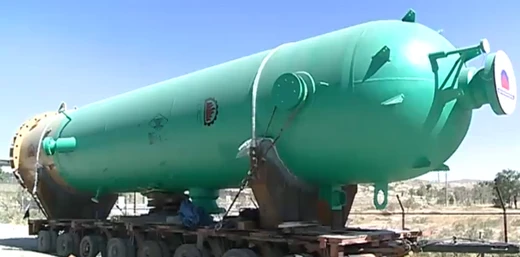
Continuous stirred-tank reactor
Model for estimating variables in continuous agitated-tank reactors.

Own work · CC0
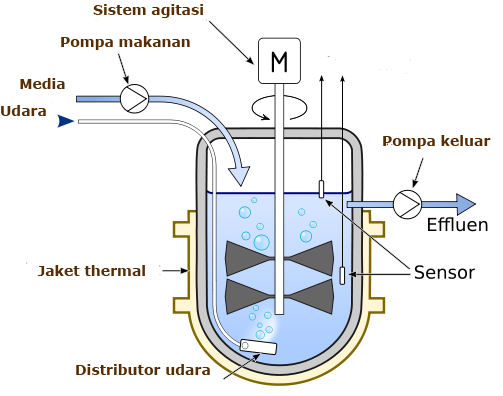
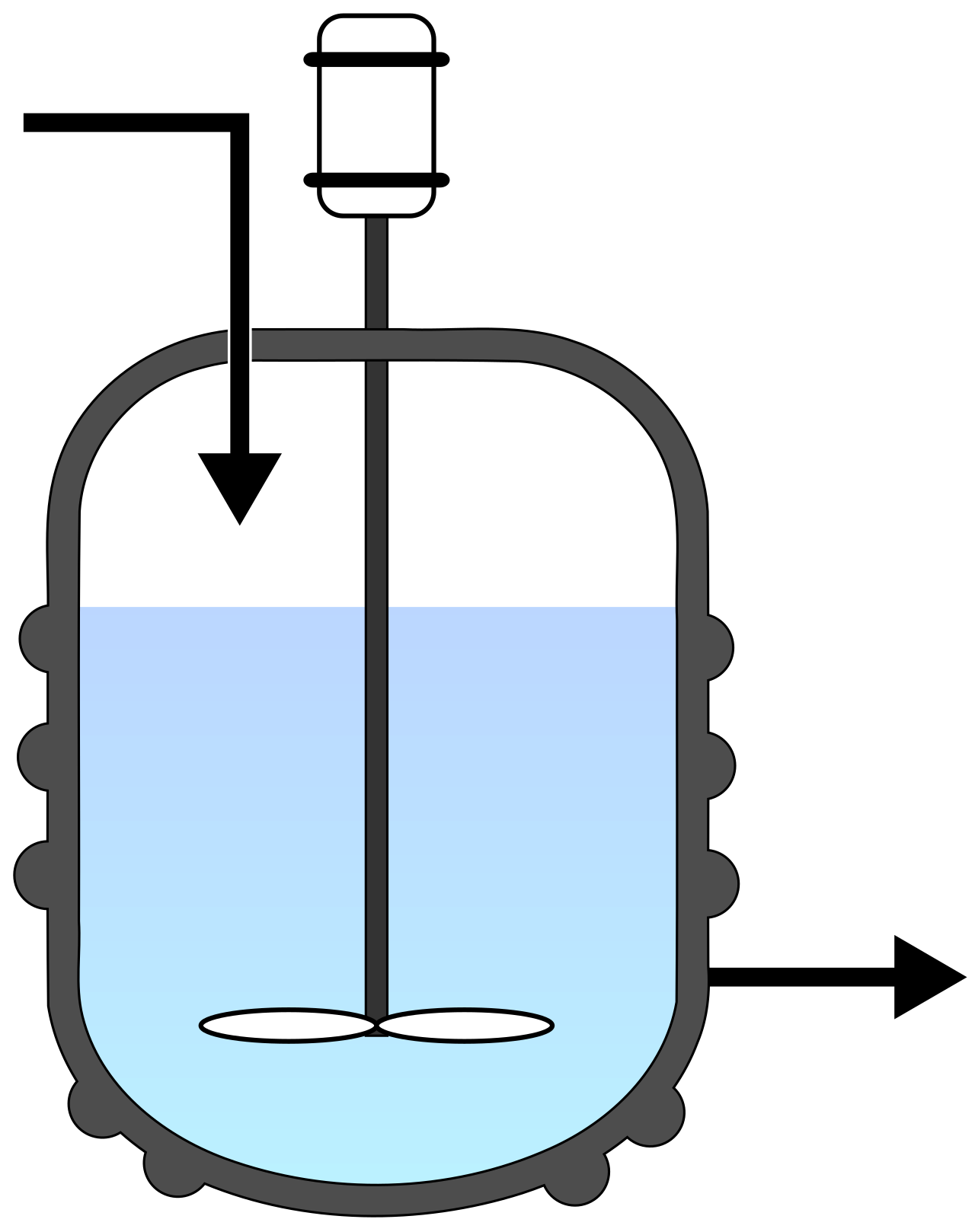
The continuous stirred-tank reactor (CSTR), also known as a vat- or backmix reactor, mixed flow reactor (MFR), or continuous-flow stirred-tank reactor (CFSTR), is a common model for a chemical reactor in chemical engineering and environmental engineering. It is used to estimate key unit operation variables when employing a continuous agitated-tank reactor to achieve a specified output, and its mathematical model applies to all fluids: liquids, gases, and slurries.
- field
- Chemical engineering, environmental engineering
- known_for
- Model for continuous-flow stirred-tank reactors; ideal limit of complete mixing in reactor design
- type
- Reactor model
- key_assumptions
- Perfect mixing, steady state, closed boundaries, constant fluid density, isothermal conditions, single irreversible reaction
Lore & Background
The CSTR model assumes perfect mixing, meaning reagent is instantaneously and uniformly mixed throughout the reactor upon entry. Consequently, the output composition is identical to the composition inside the reactor, which depends on residence time and reaction rate. The ideal CSTR represents the complete opposite of a plug flow reactor (PFR), and in practice, no reactors behave ideally but fall somewhere between these two mixing limits.
Reader's Guide
The CSTR model is significant because it provides a foundational framework for designing and analyzing chemical reactors in industrial and environmental applications. Its governing equations, derived from mass balances under steady-state and perfect mixing assumptions, allow engineers to predict outlet concentrations and residence times for various reaction orders. The model's residence time distribution (RTD) reveals that not all fluid particles spend the same time in the reactor, with a small fraction never exiting—a feature that can be either advantageous or problematic depending on the application. While ideal CSTR behavior is rarely achieved in practice due to dead space or short-circuiting, the model remains essential for approximating real reactor performance, especially when the residence time is 5–10 times the mixing time. Its legacy lies in its role as a benchmark for comparing non-ideal reactor behavior and as a core concept taught in chemical and environmental engineering curricula.
Did You Know?
- The CSTR is also called a backmix reactor, mixed flow reactor (MFR), or continuous-flow stirred-tank reactor (CFSTR).
- In an ideal CSTR, the output composition is identical to the composition of material inside the reactor.
- The theoretical residence time τ is always equal to the reactor volume divided by the fluid flow rate.
- Non-ideal hydraulic behavior in CSTRs is commonly classified as dead space or short-circuiting.
Naming and Role in Process Engineering
The continuous stirred-tank reactor carries a remarkable variety of names across the engineering literature. Practitioners may call it a vat reactor, a backmix reactor, a mixed flow reactor, or a continuous-flow stirred-tank reactor, yet all of these labels point to the same fundamental concept. In both chemical engineering and environmental engineering, the CSTR serves as a standard modeling tool for estimating the critical variables of a unit operation when a continuously agitated tank is employed to achieve a target product output. What makes this model particularly versatile is its fluid-agnostic nature: the underlying mathematics applies equally to liquids, gases, and slurries, meaning a single analytical framework can be deployed across an enormous range of industrial and environmental applications. Rather than describing one specific piece of hardware, the CSTR model represents a conceptual idealization that engineers use to predict how reactants will behave under continuous flow conditions, making it one of the most widely referenced constructs in reactor design coursework and practice.
Perfect Mixing and the Spectrum of Reactor Behavior
At the heart of the ideal CSTR model lies the assumption of perfect mixing, a condition in which every molecule of reagent entering the vessel is instantaneously and uniformly dispersed throughout the entire volume. Under this assumption, the composition of the material leaving the reactor is exactly the same as the composition inside it, and both are governed by two parameters: the residence time and the reaction rate. This ideal represents one extreme of a broader spectrum of reactor behavior. At the opposite end sits the plug flow reactor, in which fluid elements travel through the vessel without any lateral mixing whatsoever. In reality, no physical reactor achieves either extreme. Actual equipment always falls somewhere along the continuum between complete backmixing and perfect plug flow, and the CSTR model provides the upper bound of mixing against which real devices are benchmarked. This makes the ideal CSTR not a description of a specific machine but a limiting case that anchors the entire field of reactor design.
From Mass Balance to the Residence-Time Equation
The mathematical backbone of the CSTR model begins with an integral mass balance applied to the number of moles of a reactant species within a reactor of defined volume. In its general form, the rate of accumulation of that species equals the difference between what flows in and what flows out, plus any net generation or consumption by chemical reaction. When the steady-state condition is imposed, the accumulation term vanishes, and the equation simplifies dramatically. The molar flow rates at the inlet and outlet are then expressed as the product of the volumetric flow rate and the respective concentrations of the species. After algebraic rearrangement, the reaction rate emerges as a function of the volumetric flow rate, the reactor volume, and the concentration difference between inlet and outlet. Dividing the flow rate by the volume yields the theoretical residence time, a quantity defined as the total duration a discrete parcel of reagent spends inside the vessel. The final compact relationship states that the reaction rate equals the reciprocal of residence time multiplied by the concentration drop across the reactor, elegantly linking flow, geometry, and chemistry in a single expression.
Assumptions That Bound the Model's Validity
The CSTR model rests on a carefully defined set of assumptions that simultaneously simplify the mathematics and delineate the conditions under which the results remain physically meaningful. Beyond perfect mixing and steady state, the model presumes closed boundaries so that no material crosses the vessel walls. Fluid density is held constant, an approximation that holds well for most liquids but is valid for gases only when there is no net change in the total number of moles and no drastic temperature swing. The reaction kinetics are described by an nth-order rate law with a constant rate coefficient, which in turn requires isothermal operation so that temperature-dependent parameters do not vary across the vessel. The model further assumes a single, irreversible reaction in which all of the limiting reactant is converted to products, with a stoichiometric coefficient of negative one for the species of interest. Each of these constraints narrows the model's domain of applicability, and engineers must verify that real operating conditions approximate these idealizations before relying on the resulting predictions for design or scale-up decisions.
Gallery

Frequently Asked Questions
Who is Continuous stirred-tank reactor?
CSTR is an idealized reactor model used in chemical and environmental engineering to represent a vessel in which incoming fluids are instantly and perfectly blended throughout the entire volume. It also goes by several aliases, including backmix reactor, mixed flow reactor, and CFSTR.
What are CSTR's powers/role?
Its primary role is to let engineers estimate key operating variables—such as residence time, conversion, and required vessel volume—when sizing a continuous agitated-tank system for a target product output. The mathematical framework it provides applies universally across liquids, gases, and slurries.
How does CSTR's story end?
In the model's steady-state "ending," the composition and properties of the stream leaving the vessel are identical to the well-mixed interior, so the outlet fully represents the reactor's contents at every instant. This makes predicting the final product stream straightforward once the key assumptions hold.
Why is CSTR important?
It represents the ideal limit of complete mixing in reactor design, giving engineers a clean baseline against which more complex, non-ideal vessels can be compared. Because of its simplicity and broad applicability, it remains a foundational tool in both chemical and environmental engineering practice and education.
What are CSTR's key assumptions (its 'character traits')?
The model assumes perfect mixing, steady-state operation, closed boundaries, constant fluid density, isothermal conditions, and a single irreversible reaction. These simplifying traits are what keep the governing equations tractable while still capturing the essential behavior of a well-agitated tank.
More in Chemical Reactors And Processes 1-24
Elsewhere in the Chemical Reactors And Processes universe
Spotted an error? Know more?
This is a living reference — every entry is fact-audited, and reader corrections feed straight into our audit queue. Suggest an edit · See this site's audit record